
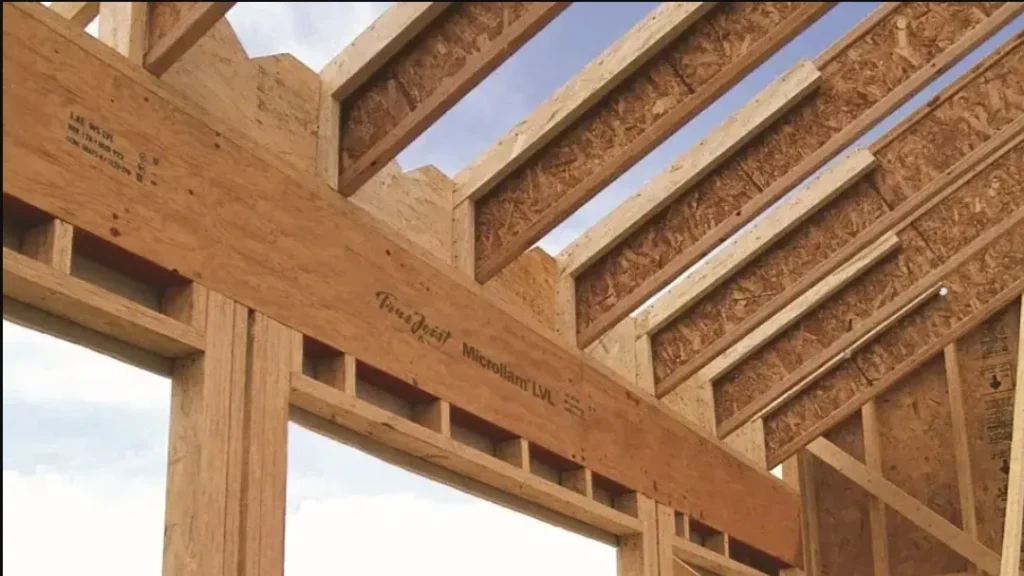
Labor shortages across the U.S. construction industry have pushed contractors toward materials that reduce on-site fabrication time. Laminated veneer lumber (LVL) fits this need precisely: it arrives pre-engineered, cut to specification, and ready to install without the field-sorting, crown-checking, and waste associated with dimensional lumber. Companies like RedBuilt offer LVL alongside a full line of engineered wood products for commercial framing, and the global LVL market reflects that demand, reaching $5.5 billion in 2024 with projections to $6.9 billion by 2033.
How LVL is manufactured
LVL production begins with rotary-peeled wood veneers, typically 1/10 to 1/8 inch thick, sourced from softwood species such as Douglas fir, southern yellow pine, or Radiata pine. These veneers are dried to a moisture content of 6 to 8 percent, graded ultrasonically for stiffness, and layered with their grain oriented parallel to the member’s length. A structural adhesive bonds the layers under heat and pressure in a continuous press, producing billets up to 80 feet long.
The parallel grain orientation distinguishes LVL from plywood, where adjacent layers alternate grain direction. By aligning all veneers in the same direction, LVL maximizes bending strength and stiffness along its primary axis. Cross-banded versions, where occasional perpendicular layers improve dimensional stability and split resistance, are available for applications where lateral fastener loads matter.
The manufacturing process neutralizes the natural defects that limit solid sawn lumber. Knots, slope of grain, and density variations are distributed randomly across dozens of thin layers, producing a composite material with highly predictable engineering properties. Published design values for LVL carry lower variability than sawn lumber, which means engineers can specify tighter safety factors and use less total material for the same structural performance.
Structural applications in commercial buildings
LVL serves multiple roles in commercial framing. Headers above window and door openings carry the loads from above and transfer them to the adjacent framing. Beams span openings in floor and roof systems where joists or trusses need intermediate support. Columns resist axial compression loads in multi-story buildings. Each application exploits a specific property of the material.
As beams, LVL members span 20 to 40 feet in typical commercial floor systems depending on depth, loading, and support conditions. A 1.75-inch by 14-inch LVL beam carries an allowable bending stress of roughly 2,900 psi, placing it well above standard sawn timber and competitive with lower grades of glulam. For heavier loads, multiple LVL plies bolt together to form built-up beams, a simple field assembly that lets contractors adjust capacity without ordering custom sections.
Columns made from LVL handle the compressive loads in post-and-beam commercial structures. The uniform density and straight grain provide consistent load-bearing capacity with minimal risk of the buckling failures that plague sawn timber columns with hidden defects. In warehouse, retail, and small office construction, LVL columns support roof loads at wider spacing than dimensional lumber posts, reducing the number of columns on the floor plan and giving tenants more usable space.
Advantages over traditional lumber and steel
Dimensional lumber carries moisture content that varies from 12 to 19 percent at delivery, depending on species, region, and storage conditions. This moisture drives shrinkage, warping, and checking as the building dries out after enclosure. LVL’s factory-controlled moisture content of 6 to 8 percent virtually eliminates post-installation movement. Floor systems framed with LVL beams and headers stay flat, partitions remain plumb, and finish materials applied over the structure perform as designed.
The durability of LVL under sustained loading conditions exceeds that of sawn lumber. Creep deflection, the gradual sag a beam develops over years of constant load, is lower in LVL because the adhesive bond between veneers prevents the fiber slippage that occurs in solid wood. This makes LVL a strong choice for headers and beams in architecture where long-term performance under dead loads is critical.
Compared to steel, LVL offers a strength-to-weight ratio that simplifies handling on site. A 14-inch LVL beam weighs approximately 8 pounds per linear foot, while an equivalent steel W8x10 beam weighs 10 pounds per linear foot and requires different tools, fasteners, and connection hardware. LVL accepts standard wood screws, bolts, and joist hangers, keeping the framing crew’s toolkit consistent throughout the building process.
The cost comparison favors LVL in many commercial applications. Steel pricing fluctuated 8 to 12 percent in late 2023 and early 2024, with lead times stretching to 16 to 20 weeks for pre-engineered metal joists. LVL maintains more stable pricing because its raw material (wood fiber) is domestically sourced and less exposed to the international commodity swings that affect steel mills. For general contractors managing project budgets, price stability reduces the contingency line items that eat into profit margins.
Design flexibility and customization
LVL beams and columns can be manufactured in virtually any length up to 80 feet, limited primarily by transportation logistics rather than production capability. Standard widths of 1.75, 3.5, 5.25, and 7 inches correspond to conventional framing dimensions, simplifying connections to stud walls, joists, and panels.
For architects, LVL offers design options that sawn lumber cannot. Long, straight members support open floor plans without the sag or deflection variability that limits solid wood spans. Custom depths accommodate specific load requirements. When paired with engineered I-joists and open web trusses in a unified framing package, LVL beams tie the structural system together with consistent material properties across all components.
The carpentry trades appreciate LVL’s workability. It cuts cleanly with standard circular saws, accepts nails and screws without splitting, and holds fasteners securely in the dense, consistent substrate. These handling characteristics keep installation rates high and reduce the callbacks associated with split headers, twisted beams, or failed connections in sawn timber framing.
Market growth and commercial adoption
North America dominates the global LVL market with approximately $2.29 billion in sales in 2024, driven by the U.S. construction sector. The commercial segment is growing at a projected 6.1 percent compound annual rate through 2033, outpacing residential growth as more architects and engineers specify engineered wood for mid-rise and institutional buildings.
Mass timber construction has accelerated LVL adoption. Office buildings represented 45 percent of new mass timber projects in 2023, a category where LVL beams and columns serve as primary gravity-load members alongside cross-laminated timber (CLT) floor panels. The USDA’s 2023 Climate Smart Forestry Program further supports wood-based commercial construction by funding research and pilot projects that demonstrate the carbon benefits of building with timber.
Production capacity is expanding to meet this demand. Metsä Wood announced a new mill that will increase its Kerto LVL capacity by 50 percent to 160,000 cubic meters per year beginning in the second half of 2026. This expansion signals the timber industry’s confidence in sustained commercial demand for LVL over the coming decade. LVL continues earning its place in commercial construction because it solves the fundamental problems that slow projects down: material inconsistency, field waste, moisture-related callbacks, and unpredictable pricing. For builders framing the next generation of offices, schools, retail centers, and mixed-use buildings, LVL delivers the structural support these projects require with the jobsite efficiency contractors demand.
